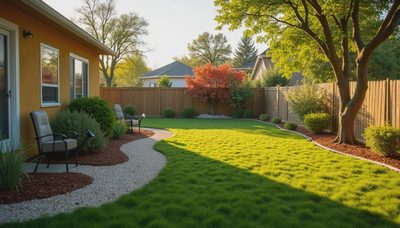
I spent one Saturday planting ornamental grass along our front walk, then spent the next three Saturdays discovering that ornamental grass still needs trimming, dividing, and hauling away. Tim, my civil engineer husband, called it a predictable maintenance schedule. I called it a personal insult. That is how I started researching no maintenance landscaping — not as a fantasy of never touching the yard, but as a system that reduces recurring work to a manageable minimum.
The honest version is low-maintenance landscaping. Every outdoor space needs occasional watering, pruning, weeding, or cleanup. The goal is to remove the high-frequency tasks: weekly mowing, delicate annuals, thirsty lawns, and plants that flop into the walkway after one storm. Trust the tape, not your eye — and measure the hours before buying the plants.
Start with a maintenance budget
Before choosing a plant, record the actual problem. A 600-square-foot front yard with a 20-by-30-foot lawn might take 30 to 45 minutes to mow, edge, and blow each week during the growing season. Over 25 weeks, that is roughly 12 to 19 hours before counting fertilizing, reseeding, and watering. No maintenance landscaping begins by replacing those repeated tasks with surfaces and plants that behave predictably.
Make three columns: weekly work, seasonal work, and expensive surprises. Weekly work includes mowing and hand-weeding. Seasonal work includes cutting back perennials and spreading mulch. Surprises include dead shrubs, clogged drains, and erosion after heavy rain. Give each item a rough annual cost. A $400 shrub that dies every two years is not cheaper than a $700 group of durable plants that lasts a decade.
I use a five-minute rule at the garden center. If I cannot identify the mature height, mature width, sunlight requirement, and watering expectation in five minutes, I do not buy it. The plant can be beautiful and still be a terrible employee.
Replace lawn strategically, not all at once
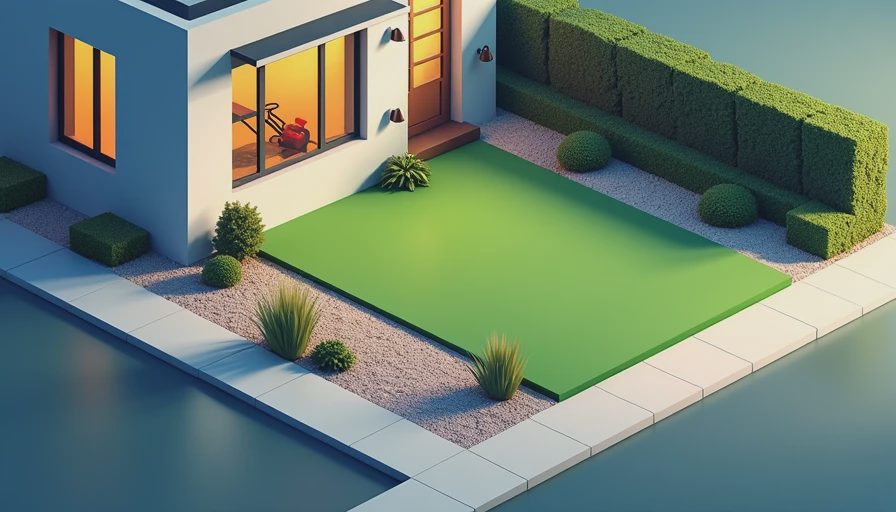
Removing every blade of grass in a weekend sounds efficient. It is usually how people create a muddy, expensive rectangle that demands a second project. For no maintenance landscaping, convert the least useful lawn first — narrow strips beside the driveway, steep slopes, shaded areas where grass grows thin, and awkward corners that require a string trimmer.
A typical 300-square-foot conversion might include cardboard or sheet mulch, three inches of quality mulch, a stone path, and 12 to 20 drought-tolerant plants. Material costs can range from $500 to $1,500 depending on delivery, edging, and whether you install the work yourself. That is not pocket change, but compare it with repeated mowing and the cost of correcting a rushed full-yard demolition.
Keep a clear transition between lawn and planting bed. Steel edging, large natural stone, or a defined paver border prevents mulch from migrating into the grass. The edge should be visible from a standing position — approximately three to four inches above the soil is usually enough to guide maintenance without becoming a tripping hazard.
Choose plants that match the site
The best no maintenance landscaping plant is not the toughest plant in a catalog. It is the plant suited to your exact conditions. A sun-loving sedum will struggle beneath an old maple. A moisture-loving fern will not enjoy a south-facing foundation bed that reflects afternoon heat.
For sunny, reasonably dry locations, consider options such as creeping thyme, catmint, Russian sage, black-eyed Susan, coneflower, sedum, and ornamental grasses selected for your climate. In partial shade, hostas, heuchera, foamflower, hellebores, and certain native woodland plants can perform better. In wet spots, use plants that tolerate moisture rather than trying to force a dry-garden palette into a drainage problem.
Read the mature dimensions, then add clearance. If a shrub reaches six feet wide, do not plant it 18 inches from the porch because it looks small in a one-gallon pot. That is how the future pruning bill gets created. I measure from the plant's center to the wall, walk, or window — then check the measurement again because my first estimate is often optimistic.
Mulch, hardscape, and drainage do the heavy lifting
Mulch is not a personality. It is a maintenance tool. A two- to three-inch layer can reduce exposed soil, slow evaporation, and make small weeds easier to remove. Keep mulch away from siding, tree trunks, and the house foundation. Against wood siding, I leave enough separation for airflow and inspection; against tree trunks, I avoid the volcano shape that holds moisture against the bark.
Stone is useful where plants will be trampled, but it is not automatically maintenance-free. Gravel can scatter onto sidewalks, collect leaves, and become uncomfortable beneath a dog’s paws. Use it in contained zones with a firm border, not as a loose blanket beside every walkway. Large pavers, stepping stones, and a compacted path surface often require less seasonal raking.
Drainage deserves priority over decoration. If water pools near the foundation, solve the slope, downspout discharge, or soil problem before installing a beautiful bed. No maintenance landscaping that ignores water will remain low maintenance for long.

Build a layout that is easy to service
Leave access lanes. A planting bed packed wall-to-wall may look finished on installation day, but it becomes a puzzle when you need to reach a hose bib, basement window, or utility meter. I aim for at least 24 inches of usable access where a person needs to walk, and wider clearance for wheelbarrows or trash bins.
Group plants by water needs rather than mixing thirsty and drought-tolerant varieties for visual contrast. The thirsty plants can share one irrigation zone, while tougher plants receive less frequent watering after establishment. This simple grouping prevents overwatering the entire bed to save one struggling shrub.
Use repetition instead of collecting one of everything. Three matching grasses or five repeating perennials usually create a calmer, more intentional view than 14 unrelated specimens. Repetition also simplifies replacement. If one plant fails, you know what to buy rather than beginning another research project in the garden center aisle.
For a dog-friendly yard, avoid sharp gravel in high-traffic routes, toxic plants you know your pet will chew, and dense shrubs that trap sticks and leaves. Keep a washable water bowl on a hard surface, not in the middle of a planting bed. The dog will choose the shortest route every time, and the landscape should account for that fact.
A realistic installation sequence
Start with a site sketch showing property lines, windows, doors, downspouts, mature trees, and utilities. Mark the areas that receive full sun, morning sun, or shade. Next, calculate square footage and material volume. One cubic yard covers about 108 square feet at three inches deep, so a 500-square-foot bed needs roughly 4.6 cubic yards of mulch. Order slightly more if the ground is uneven, but do not guess by the bag count alone.
Install drainage corrections and hardscape first. Remove only the lawn you can finish in the same project window. Add soil amendments based on a soil test instead of purchasing a cart full of products because the packaging sounds scientific. Plant in groups, water deeply during establishment, and cover bare soil with mulch.
After the first season, record what failed and why. Replace plants that need constant rescuing. No maintenance landscaping improves through editing, not through adding another fertilizer, trellis, or decorative object to compensate for a bad location.
The formula I use before spending money
Calculate annual labor hours, annual water demand, replacement risk, and access difficulty. Score each proposed feature from one to five. A lawn strip that scores five for labor and four for water is a strong conversion candidate. A front bed that scores one for labor but five for curb appeal can stay. A plant that scores five for replacement risk does not get a second chance just because it photographs well.
The best no maintenance landscaping plan is not empty, plastic, or unrealistic. It is a measured mix of durable plants, defined edges, sensible drainage, useful paths, and enough empty space to reach everything. Start with the worst chore, convert that area first, and track the result for one full season. Your yard does not need to be effortless. It needs to stop charging you interest every Saturday morning.