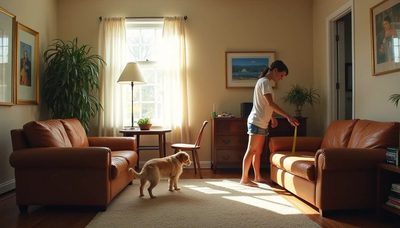
I spent one Saturday pulling weeds from a 12-foot foundation bed, then discovered half the weeds were plants I had intentionally bought. That was my introduction to low maintenance yard ideas. The goal is not a yard that never needs attention. That yard does not exist unless you pave the entire property and develop a personal relationship with a pressure washer. The goal is a yard where the work is predictable, limited, and worth the money.
My 1920s house has compacted soil, a sloping side yard, and a golden retriever who considers mulch a snack bar. So I judge every outdoor choice by four measurements: installation cost, annual labor, drainage performance, and dog resistance. Pretty comes fifth. This is not anti-pretty. It is pro-not-spending $600 on plants that die during the first hot July.
Start with the yard audit, not the garden center
Before buying anything, map the yard in three categories: areas people use, areas water crosses, and areas nobody visits unless carrying a trash bag. Measure each zone with a tape measure and sketch it on graph paper. A 20-by-10-foot bed is 200 square feet; that number matters when mulch costs $45 to $75 per cubic yard and a 2-inch layer covers roughly 160 square feet.
Watch the property after rain. Tim, who is a civil engineer and therefore incapable of ignoring runoff, pointed out that my proposed seating area sat directly in a drainage path. He was right. I moved it six feet uphill and avoided turning a $400 gravel project into a $2,000 erosion repair.
Low maintenance yard ideas work best when they solve an existing problem. If grass refuses to grow beneath a maple, stop buying grass seed. If the side gate creates a muddy dog corridor, stop adding decorative bark and install a defined walking surface. The yard is giving you a report. Read it before placing an order.
Replace high-work lawn with deliberate surfaces
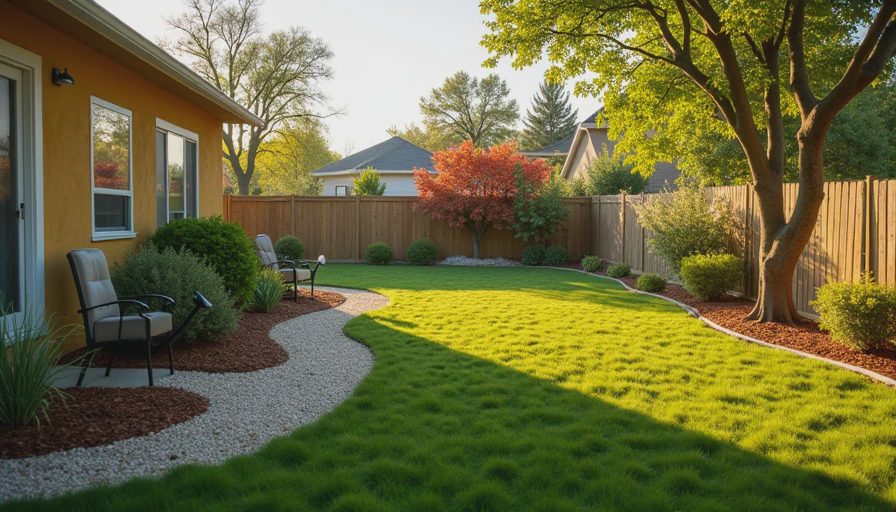
Grass is not automatically expensive, but small, awkward lawns are labor traps. A narrow strip beside a fence still requires edging, mowing, watering, and occasional reseeding. For a 300-square-foot problem area, compare the three-year cost rather than the bag price.
A 2-inch layer of shredded hardwood mulch might cost $90 to $160 installed as a do-it-yourself project, but it usually needs replenishment once or twice a year. Pea gravel may cost $250 to $600 for fabric, stone, and delivery, depending on access and depth. It does not need mowing, but it can migrate and become uncomfortable under bare feet. Large concrete pavers create a cleaner route and often land around $500 to $1,500 for a modest DIY sitting area.
For dogs, choose compacted gravel or smooth pavers over sharp crushed stone. Use edging that is at least 3 inches above the finished surface so gravel does not spread into the lawn. Leave a 3-foot-wide route from the back door to the gate; that is wide enough for a person carrying groceries and a dog making an urgent decision.
The best low maintenance yard ideas do not eliminate texture. They assign texture a job: pavers for walking, gravel for drainage, and mulch for planting beds.
Choose plants that match the conditions
The most reliable plant list starts with sunlight and moisture, not color. Track sunlight for one ordinary day. Four to six hours of direct light is a different planting condition from deep shade under an evergreen. Check your local extension office or garden center for perennial plants suited to your region, then buy fewer varieties in larger groups. Repeating three or four plants looks intentional and makes watering easier.
For a Midwest yard like mine, sturdy options can include sedges for shade, coneflower for sunny areas, black-eyed Susan, catmint, and native shrubs selected for the specific soil and moisture conditions. These are examples, not a universal shopping list. A plant that thrives in Ohio can struggle in Arizona, and a moisture-loving perennial is a poor choice for a dry slope.
Avoid planting directly against old siding or a foundation. Keep enough clearance for inspection and airflow—often 12 to 24 inches is more useful than a crowded bed. Mature plant width belongs on the sketch. A shrub labeled 6 feet wide should not be planted 18 inches from a walkway because it looks small in a one-gallon pot.
Low maintenance yard ideas become genuinely low maintenance when mature dimensions are respected. I learned this after pruning the same viburnum three times in one summer. The problem was not the shrub. The problem was my measuring.
Build a pet-friendly maintenance system
A dog changes the specification. Reserve one obvious toilet and traffic zone instead of letting the entire yard become a network of unofficial paths. A 4-by-6-foot patch of pea gravel or durable groundcover can concentrate wear, though your dog will still submit design feedback without being asked.
Skip toxic plant varieties and avoid loose cocoa mulch, which can be dangerous if eaten. Secure irrigation tubing, protect young shrubs with temporary fencing, and use a latch that a determined nose cannot open. These are inexpensive controls—often $20 to $80 each—and they prevent the more expensive repair of replacing trampled plants every spring.
For muddy seasons, put a washable mat or boot tray just inside the entry. I use a 3-by-5-foot commercial-style mat rather than a decorative 2-by-3-foot one because the extra square footage catches actual mud. Design is allowed to be practical. The dog does not care whether the mat coordinates with the planters.
Spend first on drainage and access
If water pools near the house, plants are not the first purchase. Confirm that downspouts discharge away from the foundation, clear clogged gutters, and observe whether soil slopes toward or away from the structure. A simple extension can cost under $30, while a professionally installed drainage solution can run into hundreds or thousands of dollars depending on excavation. The correct fix depends on the cause.
Create access before adding decorative features. A 30-inch path works for basic foot traffic; 36 inches feels less cramped and handles a wheelbarrow better. Place stepping stones on stable, level bases rather than directly on soil. Every uneven stone becomes a trip hazard, a mowing obstacle, and a future adjustment on your Saturday schedule.
One of the most useful low maintenance yard ideas is boring infrastructure: clear downspouts, defined edges, reachable hose connections, and paths wide enough for tools. Boring infrastructure is why the attractive parts continue working.
Use a five-minute upkeep formula
My final plan has four zones: entry, lawn or play area, planting beds, and utility edges. Each zone gets one weekly task during the growing season. I spend five minutes checking the entry, ten minutes on paths and pet areas, fifteen minutes on weeds, and another ten minutes checking irrigation or drainage. That is a 40-minute inspection, not an entire lost weekend.
Seasonally, refresh mulch, cut back perennials, clean leaves from drains, and inspect edging. Budget roughly $150 to $400 per year for a modest yard if you do most labor yourself, with extra costs for tree work or drainage repairs. Keep a simple note of what failed. My note says “do not plant thirsty things beside the dry retaining wall,” which is less poetic than a garden journal but more useful.
The repeatable formula is simple: measure the area, identify the water pattern, select materials for the actual traffic, and price maintenance for three years. Then remove one feature that requires constant babysitting. That is the point of low maintenance yard ideas—not a lifeless yard, but a yard that gives your time back. Trust the tape, not your eye.