I once installed a floating shelf 4 degrees off level. It was only 36 inches long, but every book leaned like it was escaping the house. Tim noticed before I did. This is why I started using a best laser level instead of trusting my eye, a pencil, and the optimistic belief that old plaster is somehow square.
A laser level is useful for far more than hanging art. It can establish a straight reference for cabinets, curtain rods, tile, wainscoting, shelves, and picture groupings. The best laser level for your house depends on the work: a small cross-line model is sensible for a living room, while a brighter 360-degree unit earns its price during cabinet installation or a full-room layout.
The basic rule is simple. Buy for the distance and accuracy you actually need, not the maximum number printed on the box. A $35 tool that stays in a drawer is more expensive than a $120 tool you use every month.
What a laser level actually does
A laser level projects one or more beams onto a surface. A horizontal line gives you a reference for shelves and trim. A vertical line helps align cabinet edges, wall art, and studs. A cross-line model projects both, creating a visible intersection that is especially helpful when you are working alone.
Most indoor DIY projects need accuracy around 1/8 inch at 30 feet or better. That specification sounds abstract, so translate it into a room. If your level is accurate to 1/8 inch at 30 feet, the projected line should be within roughly 1/16 inch across a 15-foot wall. That is plenty for a curtain rod, but it does not excuse measuring the brackets separately.
Self-leveling is the feature I would prioritize. The tool compensates for small setup errors, usually within a few degrees, and warns you when it cannot level itself. Manual models cost less, but they demand careful bubble reading and a stable surface. I have enough old-house variables already — sloping floors, crowned studs, and one radiator that appears to have opinions — so I choose self-leveling.
The best laser level also needs a useful mounting system. A magnetic bracket can attach to metal track, a clamp can grip a door frame, and a threaded base can sit on a camera tripod. Without a mount, even a precise laser becomes a bright line you are forced to hold with one hand while drilling with the other.

The models I would consider first
For occasional decorating work, a compact cross-line laser in the $30 to $70 range is usually enough. Brands such as BLACK+DECKER, Bosch, and Huepar offer entry-level options with horizontal and vertical lines. These are practical for hanging shelves, aligning a gallery wall, and setting the top edge of a backsplash. Check whether the package includes a wall mount; the advertised price often covers only the tool.
The Bosch GLL 30 is a familiar example of a compact cross-line design. It is easy to store, simple to operate, and appropriate for short indoor layouts. A model in this category is not intended to replace a surveyor's instrument, and its beam can become difficult to see in bright sunlight. That is not a defect if your project happens inside and your walls are under 20 feet away.
For renovation work, I would move to a green-beam model around $80 to $180. Green light is generally easier to see than red light in a bright room, although it can consume batteries faster. Huepar, Bosch, and DEWALT all sell models in this broader category. The best laser level here typically offers stronger visibility, a better bracket, and a working range that makes one-person installation less frustrating.
A 360-degree model costs more — often $150 to $350 — but it projects a continuous horizontal reference around a room. That matters when installing a chair rail, laying out upper cabinets, or transferring a level line across several walls. I would not buy one for a single picture wall. I would buy it before a kitchen project, because moving a small laser around four walls creates more opportunities for setup mistakes.
How I compare accuracy, visibility, and range
Start with accuracy, but do not stop there. A tool rated to 1/16 inch at 30 feet is attractive, yet useless if its line disappears under your work lights. For a basement with modest lighting, red is often adequate. For a sunny kitchen or room with large windows, green is easier to track. Use target cards when supplied; they make the beam more visible at a distance.
Next, look at the operating range with and without a detector. Manufacturers sometimes list a long range that requires a separate laser detector, which is mainly relevant to outdoor construction. For indoor furniture and trim, a visible range of 30 to 60 feet is generally comfortable. Do not pay for a 165-foot specification unless you can explain exactly where you will use it.
Battery type affects cost and annoyance. Standard alkaline batteries are inexpensive and easy to replace. Rechargeable USB models reduce disposable battery use, but a dead battery can stop a project unless you remembered to charge it. I prefer a tool with a battery indicator and an automatic shutoff. The latter prevents discovering a dead battery after leaving the laser on during lunch.
The best laser level should also survive a normal renovation. Look for a protective housing, a locking pendulum, and a case. The pendulum lock matters when transporting the unit; it protects the internal mechanism from unnecessary movement. Water and dust ratings are useful for garages and unfinished rooms, but do not treat a basic indoor model as weatherproof.
A five-minute test before trusting the beam
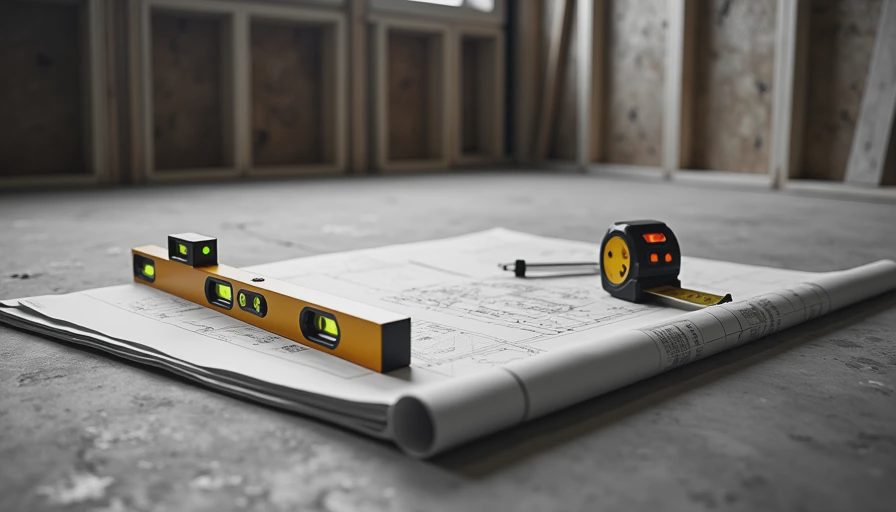
Every laser should be checked before a major layout. Place the tool about 10 feet from a wall and mark the horizontal line. Rotate the laser 180 degrees from the same position, then compare the second line with the first. A small difference is normal, but a dramatic shift means the tool needs adjustment or replacement.
I also test the vertical line against a door casing. Old casings are not always plumb, so this is not a test of the house. It is a way to notice whether the laser moves consistently when rotated. For a long wall, measure at both ends rather than assuming the line tells the whole story.
Do this check before tile, cabinets, or built-in shelving. A few minutes of testing is cheaper than removing adhesive-set tile or filling a row of incorrect screw holes. Trust the tape, not your eye — and trust a tested instrument more than either.
What I would buy at each budget
Under $50, choose a basic self-leveling red cross-line model with a tripod thread and a usable wall mount. This is the sensible choice for shelves, artwork, curtain rods, and occasional repairs. You will still need a tape measure, pencil, and stud finder because a laser establishes alignment; it does not tell you whether the wall can hold the bracket.
Between $80 and $180, choose the best laser level with a green beam, stronger mounting hardware, and a locking pendulum. This is my practical range for an old-house owner who completes several projects a year. The extra cost buys visibility and fewer awkward workarounds, not permission to skip measurements.
Above $200, consider a 360-degree model only when the project benefits from a continuous reference line. Cabinet runs, wainscoting, tile layouts, and multi-wall trim are good examples. If your next project is one shelf, keep the money for better anchors and a longer level.
My formula is simple: choose self-leveling first, match the beam color to the room's brightness, verify the working range without marketing optimism, and pay for 360 degrees only when the layout crosses multiple walls. That is the best laser level decision for most old houses — enough precision to prevent crooked work, without buying a contractor's instrument for a weekend shelf.